AUDIT REPORT
AUDIT REPORT
Audit
Report is the formal written opinion about the entity’s financial statements.
The auditor conveys the report to the management at the end of the audit.
Apart from the opinion on the statements, it also includes factual information.
It
is a medium of communication of the views of the auditor to the company’s
management. Hence, he submits the report created to the client. The report
explains the information contained in it with clarity and brevity.
The
audit report is the final product of the audit work performed by the auditor
and his staff. Noting that, the facts listed in the audit report are not
available elsewhere. Once the auditor submits the report, his duty is over, as
per the respective acts and laws.
Types
of Audit Report:
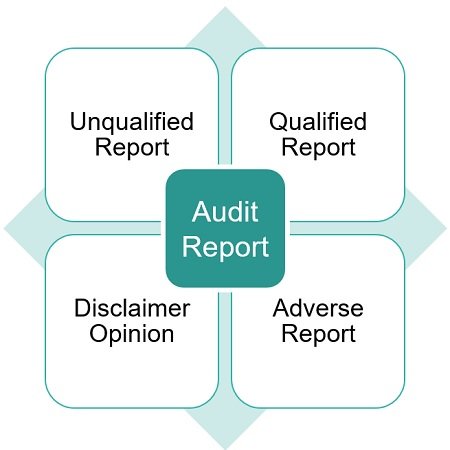
There are four major
types of audit report:

Unqualified
Report:
The
clean report is an alternative term for the unqualified report. It shows that
the company’s financial statements present a true and fair view. It does not
contain any reservations.
Qualified
Report:
Here,
the auditor doesn’t give a clean report. Rather, he expresses his opinion on
the truth and fairness, with some reservations.
Adverse
Report:
In
this, the auditor generates a report based on an examination conducted. He/She
is not in agreement with the affirmations given on the financial statements.
Disclaimer
Opinion:
Here,
the auditor is unable to give any opinion on the financial statement. He/She
denies passing any statement, after the audit.
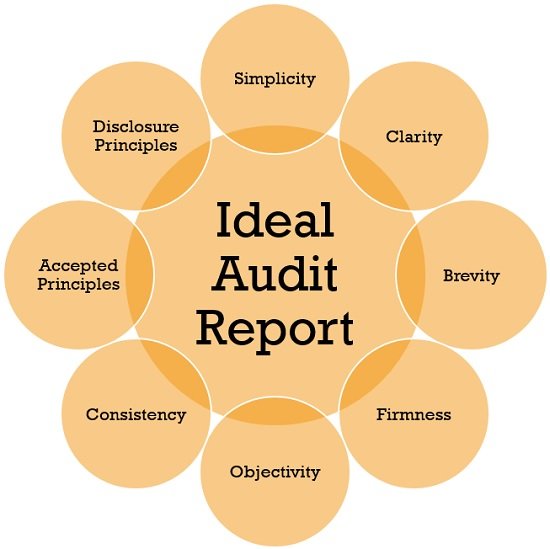
Essential
of an Ideal Audit Report:

Simplicity:
A good audit report has to be simple and clear as understandable. It should be
free from any ambiguous terms and facts.
Clarity:
Clarity is about cleanness in the audit report. It should contain all the
relevant information. The information is necessary for evaluating and
appraising the performance of the business.
Brevity:
Brevity implies the conciseness of the audit report. The auditor must avoid
repetitive use of facts and figures. This will result in keeping the length of
the report in control.
Firmness:
The audit report must demonstrate the scope of work performed. Along with that,
it shows whether the company’s account books show a true and fair view.
Objectivity:
Objective evidence should form the basis of the audit report. He should give
his opinion based on obtained information and evidence. But it must contain
monetary information only.
Consistency:
A good report must be consistent in the presentation of accounting details. It
should take into account the consistency in the method of inventory valuation.
The auditor should also check invariability in the method of depreciation.
Accepted
Principles: Fact and figures in the report have to be
in accordance with GAAPs. These facts and figures often form the basis of an
audit report.
Disclosure
Principles: The audit report must be unbiased. It
should contain all the relevant facts and truth.
Contents of Audit Report:

Signing of the Audit Report:
Referring
to section 229 of the Companies Act, 2013, the auditor must sign an audit
report. If the audit firm is an auditor, then any partner who is practising in
India has the authority to sign the report.
As
per section 230, the auditor must read the report presented in front of the
shareholders. This reading takes place in the annual general meeting of the company.
Besides, any member of the company can inspect the report, as they keep it open
for the members.
M.Karthikeyan (22UCM021)
N.Mohan (22UCM026)

Good information 👌🏻
ReplyDeleteNice information ✨
ReplyDeleteNice information
ReplyDeleteGOOD INFORMATION
ReplyDeleteGood
ReplyDeleteNice information
ReplyDeleteGood information
ReplyDeleteGood information
ReplyDeleteGood information
ReplyDeleteGood information
ReplyDeleteGood information
ReplyDeleteThis comment has been removed by the author.
ReplyDeleteNice information
ReplyDeleteGood information
ReplyDeleteGood information
ReplyDeleteGood information
ReplyDeleteNice information
ReplyDeleteGood
ReplyDeleteGood 👍
ReplyDeleteGood information
ReplyDeleteUseful information 👍
ReplyDeleteVery informative
ReplyDeleteGood information
ReplyDeleteGood information 👍
ReplyDeleteGood information
ReplyDeleteNice
ReplyDeleteNice information
ReplyDeleteGood information
ReplyDeleteGood information
ReplyDeleteGood information 👍🏻
ReplyDeleteGood information
ReplyDeleteNice information
ReplyDeleteNice information
ReplyDeleteGood information
ReplyDeleteInformative
ReplyDeleteNice information
ReplyDeleteNice information
ReplyDeleteThis comment has been removed by the author.
ReplyDeleteReally a useful information
ReplyDeleteGood information
ReplyDeleteGood information
ReplyDeleteGood information
ReplyDeleteGood information
ReplyDeleteGood information
ReplyDeleteUseful and good information..
ReplyDelete